




Rwanda has received its first petroleum cargo through the Port of Mombasa under a new government-to-government framework expected to increase the volume of fuel transported through Kenya’s Northern Corridor tenfold.

The MT Sea Wolf, carrying 40,000 metric tonnes of refined petroleum products for the Rwanda National Energy Company (RNEC), berthed at the Kipevu Oil Terminal on Tuesday.
Kenya Ports Authority (KPA) Chief Executive Officer Captain William Ruto said the shipment marked the beginning of Rwanda’s use of the Port of Mombasa for petroleum imports through the Northern Transport Corridor.
“Today marks a major milestone as we welcome Rwanda’s first maiden petroleum cargo under the new government-to-government framework here at the Port of Mombasa,” Ruto said.

He said Rwanda was one of Kenya’s key transit markets and assured Rwandan stakeholders of efficient handling of their petroleum cargo.
Ruto added that KPA had invested in infrastructure to improve vessel turnaround times.
“Our new Kipevu Oil Terminal can handle three tankers with a 170,000 Deadweight tonnage simultaneously, ensuring that oil tankers can discharge efficiently and in record time,” he said.
Kenya Pipeline Company (KPC) Acting Managing Director Pius Mwendwa said the vessel’s arrival marked a new chapter in Kenya-Rwanda energy cooperation.
“Today marks a remarkable and defining moment! MT Sea Wolf, laden with 40,000 metric tonnes of RNEC’s maiden cargo, berthed at Kipevu, and a new chapter in Kenya-Rwanda energy cooperation began,” Mwendwa said.
He said KPC’s infrastructure was ready to handle increased volumes of petroleum bound for Rwanda.
The company operates a 1,342-kilometre pipeline network with an annual capacity of approximately 14 billion litres and storage capacity of 1.138 billion litres.

“Rwanda-bound volumes through Kenya are now set to grow from approximately 60,000 cubic metres a year to 600,000 cubic metres a year, a tenfold increase,” Mwendwa said.
Energy and Petroleum Cabinet Secretary James Opiyo Wandayi said the shipment follows an agreement signed by Kenya and Rwanda on June 29th on the importation of bulk refined petroleum products.
“MT Sea Wolf’s arrival, carrying the Rwanda National Energy Company’s (RNEC) maiden cargo of 40,000 metric tonnes of refined petroleum products, close to a full month’s consumption for Rwanda, confirms that Kenya is ready to be Rwanda’s gateway to the world energy markets and the preferred route for Rwanda’s petroleum imports through our Northern Corridor,” Wandayi said.
Wandayi said the framework would go beyond the maiden shipment, with Kenya committing to provide a reliable transit environment as Rwanda-bound volumes increase.
“This is a long-term partnership, not a one-off gesture,” he said.
He added that Kenya could in future provide Rwanda with finished petroleum products from the planned Lamu Refinery, creating another potential source of supply for the country and the wider region.
Rwanda’s Minister of State in the Ministry of Infrastructure, Armand Zingiro, said the new arrangement would help Rwanda diversify its petroleum import routes and strengthen energy security.
“Rwanda is a landlocked country that imports all of its petroleum products,” Zingiro said.
He said disruptions to international shipping routes and volatility in global oil markets had reinforced the need for Rwanda to diversify its supply routes.
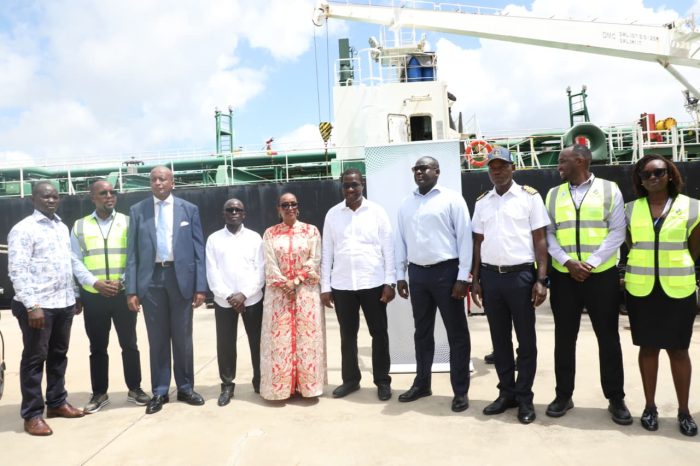
“Our Government’s response has been deliberate, to diversify our import routes and collaborate with our regional partners. This framework with Kenya is the practical expression of that strategy, and strengthens our energy security,” he said.
Zingiro also said Kenya’s extended storage terms at Kipevu would give Rwanda additional flexibility as it expands its own strategic fuel reserves.
He said the two countries’ cooperation on petroleum supply forms part of broader regional integration under the East African Community.
“As we mark this milestone, Rwanda reaffirms its commitment to this partnership and to the wider vision of regional integration that binds our two countries under the East African Community,” Zingiro said.
The new arrangement is expected to strengthen Kenya’s role as a transit route for Rwanda’s petroleum imports while expanding trade and energy cooperation between the two countries.